
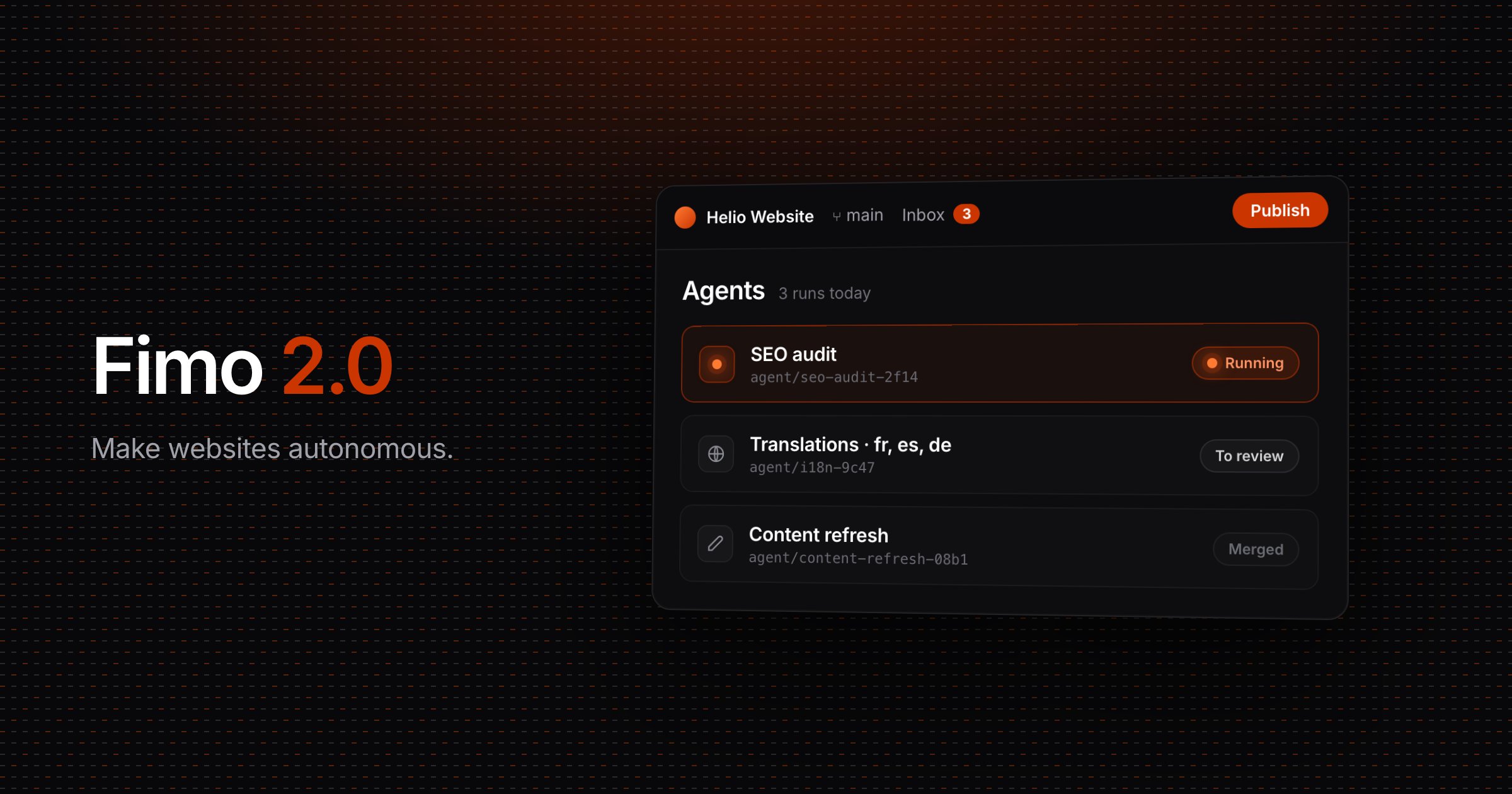
Getting a website live is the easy part now. Fimo is the autonomous website platform that keeps your code and handles everything after launch.
Getting a website online used to be the hard part. It isn't anymore. Your coding agent will take you from an empty folder to something live in an afternoon, and it will do it well.
What nobody has solved is the six months after that. The site goes up, and nobody touches it again. Traffic stays flat. Ask ChatGPT what to use, and your competitors get named. The rest piles up behind it: a design token moves, three pages keep the old one. A meta tag breaks, nobody notices. The translations never happen. None of that is anyone's fault. The people who could do the work are busy building the company.
Today, we're launching Fimo, the autonomous website platform: you keep your code, and Fimo handles everything after.
Where Fimo sits
You already have a way of working, whether that's Claude Code, Codex, or Cursor, and it works. What's missing is the layer after: something that keeps the site editable for the rest of your team, and agents that keep improving it on their own once it's live.
Fimo starts from the site you already have, in the repository you already own.
What that looks like
You bring your own stack. Run npx fimo@latest init in the code you already have. The CLI connects your repo, then hands you a prompt to paste into your coding agent, which does the migration itself. What comes back is an editable, autonomous-ready site. No rebuild to schedule, no CMS project to survive, no proprietary layer sitting between you and your codebase. Whatever you were building with, you keep building with.
Your team edits anything, visually. Fimo integrates an AI-native CMS that sits on top of your real code, so anyone can click a piece of text, a link, an image, or a video, change it on the spot, without touching the code. They can do it in-line on the live page, in a chat, or through the CMS. Ask for something bigger, like a new page, and the chat takes it from content into code. A headline change stops being someone else's ticket, and every edit still lands in the repository as a clean commit.
Agents take on the work you never get to. SEO content and technical fixes, internal linking, GEO so that LLMs cite you, translations the moment you publish, a competitor digest every other week, or one you write yourself. An agent is a folder in your repo: a goal, a schedule, and a tone if you want one. You give it a brief, and it works while you're doing something else. When an agent wants your sign-off, it asks in Slack or Teams, and you clear it in a minute. Which agents publish on their own and which always check with you first is your call.
Every agent works in its own environment. Each one gets a dedicated server, database, and asset bucket, spun up per branch, so nothing ever experiments in production. When the work is done, you read a single diff covering code, schema, and content together, instead of piecing it together from three places. And when an agent gets something wrong, it gets it wrong in a copy. Delete the branch, and the experiment never happened.
One command puts it all live. npx fimo@latest deploy publishes your site and your agents together, with hosting, SSL, CDN, and custom domains included. Every branch gets its own preview URL so you see the real thing before anyone else does, and a bad release rolls back in a click. Agents deploy separately, too, so shipping a new agent never redeploys the whole site. There's no second pipeline to maintain.
From the team that built Strapi
Ten years ago, we started Strapi, the leading open-source headless CMS, with 70K+ GitHub stars, and a content infrastructure serving millions of developers since. That is a decade of building content layers, now distilled into a platform built for the agent era.
What's next
Agents are the part we're most excited about, and the part that will move fastest. A library of ready-made agents is coming soon, along with an ecosystem where people publish their own, and every specialized agent that exists is one more thing off your plate.
We'd rather build the rest of it with you than guess. Tell us what works and what doesn't. We're on Discord every day.
One site, every job on your team: see what changes for founders, marketers, or developers.

%20%E2%80%94%20cover.png?w=2400&q=85&fit=cover&f=auto)